Showing posts with label Soccer. Show all posts

Wednesday, August 24, 2011

FIFA is $occer


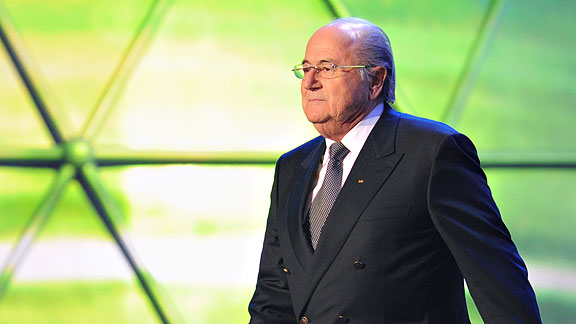
- 18th FIFA President and corrupt mofo, Sepp Blatter

Check out this excellent piece on the evolution of FIFA into its modern, corrupted form. Here's a key excerpt on how FIFA revolutionized the way the rest of the sports world thinks about sponsorships and money:

At his first dinner as [FIFA's 17th] president, [João] Havelange encountered the German businessman Horst Dassler, the son of the founder of adidas. Dassler, an aggressive, manipulative entrepreneur who was then serving as the CEO of adidas France, had thought a great deal about how to capitalize on the explosion in the popularity of televised sport. Over a series of meetings, Havelange, Dassler, and Dassler's partner, Patrick Nally, devised what eventually became the template for modern sports sponsorship. As the soccer historian David Goldblatt writes in The Ball is Round, the plan had four components:

First, only the very largest multinational companies, whose advertising budgets could bear the load and whose global reach matched the TV audience on offer, should be approached as sponsors. Second, sponsorship and advertising would be segmented by product type: There could be only one soft drink, one beer, one microelectronics firm, or one financial services company that could be the official World Cup product or supplier. Third, FIFA would have total control over all forms of TV rights, advertising, stadium space, etc. Any and all existing deals in a host country would have to go. Fourth, FIFA itself would not handle the details of the sponsorship and TV deals. Marketing and TV rights would be handed over for a guaranteed sum of money to an intermediary who would sell them on.

To cover the last part, the selling of TV rights and sponsorships, Dassler created a marketing company called ISL, short for International Sports and Leisure, and established an office across the street from FIFA headquarters in Zurich.

The combined effect of Havelange's two insights [the other being support of Africa and Asia as a new power base] was to co[n]vert FIFA into a sort of hydraulic cash-flow machine.

Monday, August 8, 2011

Black & Red: MLS Power Rankings


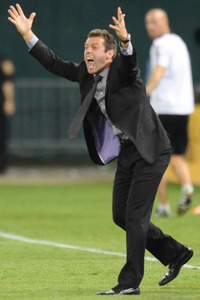
- DC United Coach Ben Olsen is not happy that his biggest fan ranks his side at #9

If you like MLS, you are probably reading a proper football blog instead of this tripe. So, you'll already know that you should be reading the SB Nation blog Black and Red United, who has come up with awesome MLS Power Rankings. They are, of course, most awesome because they confirm that LA Galaxy are the best in show, at the moment, and on a clear path to defending their Supporters' Shield (best regular season performance). Now if only they could win another MLS Cup. See the full article here.

Black and Red United's Week 20 Power Rankings:
  1. LA Galaxy
  2. Seattle Sounders FC
  3. Real Salt Lake
  4. FC Dallas
  5. Colorado Rapids
  6. Columbus Crew
  7. Philadelphia Union
  8. Sporting Kansas City
  9. DC United
  10. Chivas USA
  11. Houston Dynamo
  12. Portland Timbers
  13. Red Bull NY
  14. San Jose Earthquakes
  15. New England Revolution
  16. Vancouver Whitecaps
  17. Chicago Fire
  18. Toronto FC

Monday, August 1, 2011

Jürgen Klinsmann's First Press Conference as USMNT Head Coach


Highlights from the introductory press conference with new US Men's National Team heald coach Jürgen Klinsmann:

Big focus on Klinsmann's living in the U.S. for 13 years: Is this really that big of a deal? I think this matter's more to casual and fair weather fans than the core US soccer fans who just want to see the team and game--throughout all levels of development--improve.

"The style of play should reflect the culture of the country": In the same thread, Klinsmann and US Soccer Federation President Sunil Gulati both emphasized that Klinsmann isn't going to try to impose a "European style of play" (read: German) on the US game. This is probably a good thing, since the U.S. side doesn't have the talent to dependably profit off of counter-attacks the way Germany does. But it is less clear what Klinsmann thinks the U.S.-style is/will be; he sort of punts on that follow up question and says that he'll spend the next few months talking to MLS and other U.S. coaches to get a sense of this.

"No immediate decision on coaching staff": One major marker of Klinsmann's run as German Men's National Team head coach was to immediately clean house and surround himself with coaches he trusted. It looks like that won't be happening quite the same way with the USMNT; Klinsmann says he'll take some time to work with different folks and see who meshes. Since he's starting a new cycle and won't have a major tournament (I think?) to deal with until CONCACAF Gold Cup in 2013, he has some breathing room before settling on the staff that will guide the Yanks into Brazil 2014.

"American youth" don't focus enough on soccer: In perhaps a hopeful nod to the fact that the U.S. soccer talent pipeline is broken, Klinsmann made two important comments about the development of U.S. youth players. First, he notes that, unlike European youth talent who go pro at 18, U.S. soccer players usually got to college. Don't get me wrong; I'm not saying people shouldn't go to college. But in the U.S., the only college-to-pro pipelines are in football and basketball, because in those two sports, college ball is professional sports. The players don't get paid, but they get full scholarships, and the rest of the business is just as massive as the NFL or NBA. Compare that to the other Big Three sport in the States, baseball, where really talented players go into the minors at 18, sometimes with deals with MLB for scholarships to go to college after their playing career ends. This may actually end up being a better deal for players, who get paid to train and play in the D-league even while knowing that their odds of ending up pro is slim, and getting to the highest level of the sport is slimmer. I have no idea how hockey works. In any case, it seems much more likely that youth development will succeed if soccer follows more closely to baseball, rather than football/basketball. We will see if Klinsmann's appointment will pair well with MLS moves toward a D-league (USL's PDL).

Klinsmann's second comment about youth development was that American youth talent don't spend enough time playing. He used the example of Mexican kids who will train in an organized way for maybe 4 hours a day, but then play pick-up ball or just mess around with ball skills for another 5 hours, so that they're spending pretty much every waking moment playing soccer. As I alluded to in my last post (Bradley Out, Klinsmann In), the U.S. youth development pipeline is over-reliant on organized play, on expensive traveling club soccer and college ball that excludes a lot of undiscovered talent out there. Discovering the "U.S. Style" may in large part be a matter of figuring out who we are missing; in finding that, we may discover we are much more a soccer country than we ever knew.

Friday, July 29, 2011

Good News, Soccer Fans! Bradley out, Klinsmann in!


- left, outgoing head coach Bob Bradley; right, incoming head coach Jürgen Klinsmann.

After the USMNT collapsed in the first knockout stage of the 2010 World Cup in South Africa (losing to Ghana), the calls for the removal of head coach Bob Bradley were louder than ever. Just as loud as when previous head coach Bruce Arena led the team to a Group Stage early exit in 2006 (also here losing to the Black Stars in its final game of the tournament). In USMNT soccer, it seems, the fans bear little tolerance for failure.

US soccer fans rejoiced today at the news that the much maligned Bradley has finally been fired, replaced by proven-winner Jürgen Klinsmann. Klinsmann, it is very important to remember, was who they wanted as USMNT head coach back in 2006 in the first place; the Yanks only settled on Bradley after Klinsmann declined to take the helm.

While some are already leaping to the defense of Bradley, arguing that the blame should not lie on the coach but on the players and American culture. Looking at his strengths and weaknesses, I tend to think he may have been a good national team coach eventually, but was still a child in a grown-up's world (in coaching terms) when he was thrust into the limelight. Let's take a look at both the outgoing and incoming coaches.

Bob Bradley's record as USMNT head coach:
Time: 2006-2011 (1 World Cup Cycle; appointed following 2006 World Cup)
Record: 43-25-12 (53.75% win)
Highlights: Beating UEFA Champion and World #1 Spain (and breaking Spain's 35-game unbeaten streak) in the 2009 Confederations Cup Semifinals; winning the 2007 CONCACAF Gold Cup
Low points: Losing in poor form 2010 World Cup Round of 16 to Ghana during extra time; losing the 2011 Gold Cup to Mexico 4-2 after going up 2-0 early on.
Strengths: Intelligent student of the game, focus on developing young talent (a continuation, no doubt, of his previous job coaching the U-23 national squad)
Weaknesses: Over-reliance on the broken U.S. talent development system; risk-averse; media/fan-un-savvy; us-vs-them-nationalistic mentality; tendency of starting his mediocre son Michael over more talented players

Now, let's look at the incoming USMNT coach Jürgen Klinsmann:
Record:
German Men's National Team head coach, 2004-2006, 20-8-6
Bayern Munich head coach, 2008-2009, 25-9-9
Overall, 45-17-15 (56.96% win)
Highlights: Third place in the 2006 World Cup (with a quarter-final win over Argentina); Quarter Finals result in 2008/9 UEFA Champions League
Low points: 1-4 2006 World Cup Qualifier loss to Italy.
Strengths: Aggressive stance toward front office reform and hiring successful coaching staff; focus on building institutions to foster young talent
Weaknesses: Overly offensive-minded (a big weaknesses given that the USMNT's chronically spotting backfield needs a lot of help); tendency to piss off The Bosses; lack of concern for media coverage


Klinsmann was successful at revamping the way that both the German national squad and Bayern Munich looked for and fostered talent. In a country where professional soccer isn't even mentioned as a "Big Four Sport," it is hard to predict whether the successful German model will translate. LAT sportswriter Grahame Jones offers this bit of advice for the new coach:

The answer [...] is to explore new territory. Go beyond the ranks of MLS and the U.S. players overseas. Go into the barrios. Look for kids playing in unregistered leagues. Do some real scouting at the grass-roots level. Accept that the price of long-term success might be short-term failure.

Monday, July 11, 2011

MLS: Halfway There

Adam Taylor at Black, Red & United has a great post breaking down DC United's performance so far this year. He comments that United is just on the wrong side of tie-breakers if the playoffs were to be decided today, which inspired me to look back at who makes the list right now.

With 2011 expansion teams, the league is now at 18 teams (including three in California and two in Texas). It's a very (true) West-heavy team, leading to the bizarre current split where the Texas teams are split (FC Dallas (96deg 48'W is West; Houston Dynamo (95deg 21'W is East), with Sporting Kansas City called East right up the longitude (94deg 37'W). The Western Conference also continues to be the better Conference this season. 2011 marks the first year of Wildcard playoffs, and an increase from top 2 per Conference to top 3. The seedings today would look like this (with Overall Ranking and Points in parentheses):

WEST
1. LA Galaxy (1)(39)
2. Seattle Sounders (2)(35)
3. FC Dallas (3)(34)

EAST
1. NY Red Bulls (5)(28)
2. Philadelphia Union (6)(28)
3. Columbus Crew (7)(27)

WILDCARD
7. Real Salt Lake (4)(30)(West)
8. Colorado Rapids (8)(27)(West)
9. Houston Dynamo (9)(23)(East)
10. Chivas USA (10)(22-wins hth tiebreaker w/Sporting KC, DCU, and SJ)(West)

Supporter's Shield winner, being the team with the most points at the end of the season, the overall #1 seed (right now, defending Supporter's Shield winner Galaxy) plays the lowest ranking team out of the two Wildcard matchups (7 v 10, 8 v 9). The higher ranking team out of the Wildcard would play the other Conference's #1.

Last year, if you remember, Colorado was the Eastern Conference Champions, due to the fact that the bottom four are picked for regular season performance regardless of conference. If the second half of the season looks like the first (and last season, for that matter), expect another Western-dominated playoffs, with Real Salt Lake and the Rapids forcing the East to defend their existence, yet again.

Saturday, November 13, 2010

MLS Playoffs: Then there were 4, and they were All West

So, flipping between Walking Dead episode 2 and the MLS playoffs last week wasn't too difficult, since Galaxy dominated on both sides of the pitch from start to finish (3-1 on aggregate). The bigger question is, when everyone was trying in vain to try to escape Atlanta during the Zombie Apocalypse, why didn't anyone think to drive on the incoming lanes of the highway, where there was no one, much as Glen did in his brand new muscle car at the end of the episode? Come on, people, you gotta try harder if you want to survive!

And people said that World Cup fever wouldn't spill over into increased America interest in soccer. Hah.... no one is watching these playoffs besides me, are you?

Galaxy, top seeded coming into the playoffs, is the only team that was not upset during the first round! Over last weekend, #3W FC Dallas knocked off #2W Real Salt Lake on aggregate (3-2), #5W Colorado Rapids upset #2E Columbus Crew in PKs (pens. 5-4), and #6W San Jose Earthquakes shocked #1E NY Red Bulls at Red Bulls Arena with a come from behind win on aggregate (3-2). Also, there are NO Eastern teams at all left in the finals; the Eastern Championship will be played in Colorado.

Yep. The East is super weak. It's like watching the NBA playoffs and wondering who is going to have the privilege of losing to the Lakers this year.

If you asked me who the biggest threats to the Supporter's Shield (best regular season record) winning Galaxy were going to be during these playoffs, I would have said 1) The Red Bulls, who have become the most dangerous team in the MLS since picking up Rafael Marquez and Thierry Henry, 2) Seattle in the first leg, who is often unbeatable at home (they play to the largest crowd in all of MLS, a usually sold-out ~35,000 in the Seattle Seahawk's Qwest Field), and 3) RSL, the reigning champs who upset the Galaxy in last year's MLS Cup finals at Seattle. And all three are now gone. San Jose may be a dark horse, and LA have a NorCal/SoCal rivalry, and Landon Donovan started his MLS career at the old Earthquakes (who, in a 2005 Cleveland Browns/Baltimore Ravens-esque move, are now the Houston Dynamo, with the new Earthquakes an expansion team circa 2008), but they have to get past the Rapids at Colorado for the privilege.

So we have, in the West, overall #1 Galaxy facing off against overall #5 FC Dallas at the Los Angeles Home Depot Center (actually Carson City, annoyingly), and #8 overall San Jose looking for another huge upset at #7 overall Colorado Rapids.

"Eastern" conference finals are Saturday 9:30p EDT, on FSC/FSE (haha, it's on FSE but not FSW, even thought it's two Western teams!).

Western conference finals are Sunday 9:00p EDT, ESPN2/Deportes (I might watch it on Deportes, just for fun. And also because Alexi Lalas is freaking annoying). I imagine it's going to be slightly harder for me to flip betwee Walking Dead and the Galaxy game this coming Sunday.

Tuesday, July 27, 2010

Pickup Soccer on Film: Pelada


Pickup soccer is born of a love for the game. In a way, it is a forum for self-expression - an addictive, joyful, occasionally painful, and almost always fun and surprisingly competitive place. It's a web of interwoven and evolving philosophies of self, constituting style set within a commonly-accepted framework of a substance defined by attacking and defending. It's not bland functionality of pass, dribble, shoot, but a blossoming example of human creativity and decision-making within narrowly-constructed rules. In Pelada, we witness two former college players explore the global phenomenon of soccer at the pickup level.

This couple - Luke Boughen and Gwendolyn Oxenham - is the narrative heart of Pelada. Both had hopes of going pro. Boughen has begun to move on from this dream. Oxenham, however, dwells on what could have been and wants at least one more chance. For better and worse, each view their international interactions through their respective prisms. The two travel from country to country seeking and playing in pickup games - Buenos Aires, Casola Valsenio, Nairobi, Tokyo, Jerusalem, Tehran, and more. The fields range from concrete to grass to dirt and back. What shines through, no matter where they are, is the universal love of the game. If you have a ball and a friend, you can play. And if you can play, you will.

Erich Braun, a former University of Notre Dame star, makes an appearance in the film and discusses his inability to become a professional soccer player, despite alleging that he was better than others who became professional players in Germany. Rather than explore this theme with "why?", the question becomes whether Braun has given up hope. He has. Pelada's only fault is the frequent narrative presumption of a professional/failure dichotomy that comes across as a Hoop Dreams-lite for soccer.

But Pelada's fault is minimal. Its exploration of the game is neither psychological nor geopolitical. Director Ryan White rightly shies away from the latter - this is not "How Soccer Explains the World." Regardless, the cultural subtexts of the myriad locales make themselves apparent in Oxenham's and Boughen's inherent whiteness and the reactions to Oxenham's gender. Both race and gender matter in a visit to a La Paz prison game and gender plays a major role (obviously) in the duo's trip to Iran. Across many of the countries visited, however, skill on the pitch is what matters most, and, in the end, it's the shared joy of a simple game that makes this film.

This is cross-posted at Beatbots.

Friday, July 16, 2010

Thierry Henry leaves Premier League for MLS; Can Red Bulls Capitalize on Beckham-like Acquisition?


- photo credit Matthews/AP, via NY Daily News

This week, failed French hero and 32-year-old forward for the Tottenham Hotspurs (English Premier League) announced he has signed with the New York Red Bulls of Major League Soccer. The headline from most casual soccer fans is that Thierry Henry has thus officially declared himself a has-been by signing with the much weaker MLS (even 28-year-old U.S. star Landon Donovan is having second thoughts about ending his remaining prime years in Los Angeles).

But the question for MLS fans is whether signing an aging-but-star striker like Henry, fresh off a disappointing World Cup performance, will yield better results for NY than the signing of former Real Madrid/Man U star David Beckham did for LA. For those of you who have been wondering why you haven't heard about Beckham recently, other than watching him look depressed (and yet dapper) on the sidelines while England got served by Germany, the $32 million Galaxy player tore his Achilles tendon while on loan to AC Milan, and is out for the whole season. Injury and fitness issues have plagued Beckham's time at the Galaxy, as have questions about his commitment given multiple loans and perceived lack of effort, infamously earning him boos an an altercation with a fan.

Will the story be different for Henry, who also formerly played for a perennial Premier League contender (Arsenal) and in La Liga (Barca)? Or will he suffer similar problems of ego, age, and inflated fan expectations? Just as Beckham entered a club that already featured a star at the same position (Donovan at midfielder), so too will Henry, who will be teammates with fellow striker and frequent Golden Boot contender Juan Pablo Angel. With a new soccer-specific stadium and an impressive season thus far from a previously bottom of the barrel team (the Red Bulls are second in the East, a decent enough performance to make the playoffs), the timing is right for the New York club to really make a push as a real soccer town. Whether Henry will be a key part of that push shall be determined very soon.

Friday, June 25, 2010

And The Stage is Set: Round of 16 Preview

The final games of group play have finished, and the elimination rounds of the 2010 World Cup are now set! Spain fought back from their surprise loss to Switzerland with a big 2-1 win over Chile, propelling themselves to the top of Group H and avoiding a Round of 16 matchup against Brazil, who faces Chile instead. Interesting fact, Chile gave up 7 goals to Brazil in their two matches during World Cup qualifying; not exactly the best record you want when facing the #1 team in the world.

How did the various continents do? Well, Europe did worse than last time around, and the rest of the world did better:

Europe - 6 (down from 10 in 2006)
South America - 5
CONCACAF (N. & C. Am., Caribbean) - 2
Asia - 2
Africa - 1
Oceania - 0

And who has the easiest path to the semi-finals, and who has the hardest? Let's look at the brackets (using pre-World Cup FIFA Rankings):

Weakest: #14 USA v. #32 Ghana, #16 Uruguay v. #47 S. Korea
#2 Spain v. #3 Portugal, #31 Paraguay v. #45 Japan
#1 Brazil v. #18 Chile, #4 Netherlands v. #34 Slovakia
Strongest: #6 Germany v. #8 England, #7 Argentina v. #17 Mexico

Things look good for Team USA; they are in the weakest bracket by far, and while Ghana is the strongest team in Africa and Uruguay is the original power team, the Yanks are fully capable of winning their bracket up to the semi-finals if they play the way they did back in the Confederations Cup, where they beat Spain in the semi-finals and went up 2-0 over Brazil in halftime of the finals, only to give up 3 goals in the second half. We may see a rematch of that Confederations Cup finals (held in South Africa last year), as Brazil and the USA are on the same side of the brackets, able to meet up in the semi-final match. But it won't be a cakewalk for Brazil, either; though they are heavily favored to trounce Chile yet again, they haven't looked in top form yet this World Cup (though all signs suggest they're just waiting for the elimination rounds to play their real game, which should blow us all away), and may face European powerhouse Netherlands in the quarterfinals.

On the other side, the toughest trek by far will be where perennial European powerhouses Germany and England face off. Both are playing some of the ugliest football we've ever seen them play, with England finishing second in Group C after being unable to beat Algeria and drawing with the Americans (sort of like the War of 1812). Not only should that first match be a knock-down, drag-out street fight, but the winner of the derby faces red-hot Argentina, who is one of the few teams who look like they're ready to win the whole thing, maybe even more so than Brazil. And don't count out Mexico, which has been playing like a top 10 team and may be the Cinderella story of this World Cup. Whoever comes out of this strongest group will probably face the winner of Iberian neighbors Spain and Portugal. Spain has definitely not looked like the European champions so far, with star Liverpool striker Fernando "El Nino" Torres still scoreless and an apparent inability to convert on strong chances. UEFA Euro 2008 hero David Villa (Valencia) has stepped up, though, and it will be interesting to see whether he continues to be the big finisher for La Roja (who confused me by wearing blue today in their final group match).

Portugal, too, has been lackluster, with the biggest disappointment being the lack of goals from international superstar Cristiano Ronaldo (Real Madrid) (especially after the epic Nike ad campaign). In 270 minutes, Ronaldo has hit the back of the net just once, of seven Portuguese goals. If Spain is in top form, we'll see Barca-inspired dominance of possession, meaning fewer chances for Portugal. Ronaldo will have to execute on the opportunities he does have if he hopes to make the Nike ads into a reality.

But here back home, all eyes are just focused right now on USA v. Ghana. By all measures, the USA is favored, but that's not how the World Cup works. Emotions will be running high; Ghana and the US were both in the same group in 2006, and the African Cup Champions nabbed the second slot out of group play behind Italy (remember when Italy used to make it out of group play), with Ghana beating the US 2-1 in the final group play match, sending the Yanks home and dooming Americans to another four years of pretending that the world cares about MLB's World Series. As always, Team USA has a lot to prove to proto-fans at home, and there is never a venue better than the World Cup to teach Americans to love soccer. But the Black Stars will be under a lot of pressure as well; not only are they looking to make another run in the World Cup, they're now the only remaining African team in the first African World Cup in history. It's a lot of pressure from an entire continent, and while the players and coaches claim to welcome it, how they handle it come tomorrow is yet to be seen.

Saturday
Uruguay v. South Korea, 10am EDT, 7am PDT, ESPN
USA v. Ghana, 2:30pm EDT, 11:30am PDT, ABC

Sunday

Germany v. England, 10am EDT, 7am PDT, ESPN
Argentina v. Mexico, 2:30pm EDT, 11:30am PDT, ABC

Monday
Netherlands v. Slovakia, 10am EDT, 7am PDT, ESPN
Brazil v. Chile, 2:30pm EDT, 11:30am PDT, ESPN

Tuesday
Paraguay v. Japan, 10am EDT, 7am PDT, ESPN
Spain v. Portugal, 2:30pm EDT, 11:30am PDT, ESPN

Monday, June 21, 2010

Recovering from emotional rollercoaster of USA Slovenia

It's taken two days to calm down after the Slovenia match to be able to write this. The game was the most emotional sporting event I've ever attended, by far. I got to the match and was immediately impressed by the density of American supporters. In a stadium that holds 60,000 people, there must have been at least 80% USA fans! In comparison, the England game was probably 35% American supporters in a stadium that seated 40,000.

All the supporters had come out in brilliant costumes. My favorite was a trio in NASA space suits holding signs that read "South Africa! We have landed!". I'll get up pictures as soon as I get them off my camera. The place was rocking by the time the teams came out onto the fields for their national anthems.

So we are all yelling and screaming and blowing a few vuvuzelas and then Slovenia slips through for their first goal. The oft-cited criticism is that the US leaks bad goals. My opinion after watching two games is that the critics are right. The USA leaked two bad early goals and immediately put ourselves in a hole. Timmy Howard is an amazing keeper and has definitely kept the team in the game any number of times, but if his defense won't mark up and close out and run players off the ball in the box then we are going to give up bad goals.

The stadium was very quiet after the first goal but we got back on the horse and continued urging the team on. And we had a really good attack going for a while, highlighted by Donovan's near goal that was kicked away at the last possible moment by a Slovenian defender. But then the heartbreaker - after a good ten to fifteen minutes of American domination, the Slovenians slipped in on the counter-attack. It was a beautifully played throughball, assisted by more sloppy American defending, that was slotted into the back of the net.

So there we are, thoroughly disheartened, going into the half down two-zero. Thankfully Bradley made two important changes at the half. Anyone with half an eye could have told you Findley was ineffective in the first 135 minutes of play and he was removed. Torres played a mostly uninspired defensive midfield, with the exception of one nice set piece, and was also removed. Donovan was moved up to a forward position and immediately rewarded the decision with a cracker of a goal two yards in front of the net. From there on out, it was USA almost the whole half. This is the type of soccer I came to South Africa to see! The US imposed their will on Slovenia, making nice runs, putting together crisp passes, and taking well-aimed shots.

And we were rewarded in the 80th minute with a beautifully set up play, a drop-down header from Altidore, who was playing like a rock in the front, and a slammed home volley from Bradley junior. We were back in the game!!! The crowd erupted in a roar I've never heard before. We were feeling really good and continued to press the attack. It seemed as if Slovenia was content to merely try and hang on for the draw at this point. But they could not deny the US attack and the Americans scored a beautiful goal of a Donovan set piece.

Even though the Slovenians appeared helpless before the American assault, the referee was not and blew the now-infamous phantom penalty against our side. The goal was mysteriously called back. By now there has been enough venting and complaining and I'm willing to accept the absurdity of it all. A beautiful goal nullified and no explanation given. At the match I was beyond upset. But the English draw against Algeria has put the ball firmly into the American court. It we win, we advance. That's all a team can really ask for anyway. And somehow, a win with a Slovenian loss or draw puts us through in first place, avoiding Germany in the round of 16. And thanks to a weak group A, we would most likely play Mexico or Uruguay in the quarters. It is hard to imagine a better road to the semis than that. Not an easy one, but infinitely better than facing Argentina or Brazil early on.

All in all, I'll take where we are at. I hoped for better, prayed for no worse, and now the USA is in control of its destiny. Oleeeee, ole ole, oleeee. Ole----- USA!

Saturday, May 29, 2010

World Cup to Use High-Speed Adidas Ball

"World Cup: Adidas' Jabulani Ball Promises Higher Scores, Anguished Goalies":

[F]or the 11th year, Adidas earned the right to field its version of what a world-class ball should look like.

This tournament's ball, called "Jabulani," which means "to celebrate" in Bantu, represents advances in both design and innovation.

Rather than being made of leather, which is traditional, the Jabulani ball is constructed of synthetics. Instead of 14 panels, there are only eight, which are held together by thermal bonding, not hand stitching.

That "grip 'n' groove" technology makes for improved wind channeling and, thus, a truer flight, Adidas officials say. Fewer seams also translate into a greater striking surface, making the Jabulani the roundest and most accurate soccer ball ever created.

As a result, this ball is faster than ever -- potentially making for higher-scoring games. That's a plus for markets, like the U.S., where less soccer-savvy audiences are less appreciative of a sophisticated defense than of the primal thrill of a boot into the net.

Wednesday, May 26, 2010

US National Team Announced!

Ladies and gentlemen, without further ado, your US National Team!

From US Soccer:
U.S. ROSTER BY POSITION (All-Time World Cup Roster Appearances)
GOALKEEPERS (3): Brad Guzan (2010), Marcus Hahnemann (2006, 2010), Tim Howard (2006, 2010)
DEFENDERS (7): Carlos Bocanegra (2006, 2010), Jonathan Bornstein (2010), Steve Cherundolo (2002, 2006, 2010), Jay DeMerit (2010), Clarence Goodson (2010), Oguchi Onyewu (2006, 2010), Jonathan Spector (2010)
MIDFIELDERS (9): DaMarcus Beasley (2002, 2006, 2010), Michael Bradley (2010), Ricardo Clark (2010), Clint Dempsey (2006, 2010), Landon Donovan (2002, 2006, 2010), Maurice Edu (2010), Benny Feilhaber (2010), Stuart Holden (2010), José Torres (2010)
FORWARDS (4): Jozy Altidore (2010), Edson Buddle (2010), Robbie Findley (2010), Herculez Gomez (2010)

Look at that... no Brian Ching. I have to admit, I'm surprised but happy Ching isn't there. 15 players on this team will experience their first World Cup in 3 weeks. That's an amazingly young team for a tough group. To catch the US team in their last match before the Cup begins, check out ESPN2 this Saturday at 2 pm when the US takes on Turkey in Philadelphia.

Wednesday, May 12, 2010

U.S. Men's National Team for 2010 World Cup Announced

NYT has a story, and the full list is here.

Notable stats:
  • 9 players are on MLS teams. The two L.A. teams each have two players a piece making the list: from Chivas USA, defender Jonathan Bornstein and midfielder Sacha Kljestan, and from the Galaxy, forward Edson Buddle and midfielder Landon Donovan.
  • 7 players, including all 3 keepers, play on English teams (#1 GK Tim Howard plays for Everton, where star midfielder Landon Donovan was on loan earlier this year)
  • L.A. Galaxy's Landon Donovan is the most experienced player on the squad, with 121 caps and 42 goals in international play. The Galaxy captain is 28 years old.
  • The youngest player on the team is Jozy Altidore (Villareal, Spain), at 20 years old. The oldest player is backup keeper Marcus Hahnemann (Wolverhampton Wanderers, Eng.), at 38.

Wednesday, April 28, 2010

UEFA Champions League Final: Bayern Munich v. Inter Milan

Last year, for the first time ever, the UEFA Champions League Final, which showcases the best soccer clubs in the world, was the most watched sporting event, drawing 109 million viewers worldwide, 3 million more than the Super Bowl.

I'm going to predict that this year won't be a repeat for that title.

With FC Barcelona's loss today to FC Internazionale Milano (a.k.a. Inter) on a 2-3 aggregate score in the seminfinals, the May 22 final matchup is set, pitting Inter against Bundesliga powerhouse FC Bayern Munich (a.k.a. Bayern). And while both teams are playing incredible football, there's no way this is the matchup that UEFA executives could have been hoping for. While Bayern is by far the dominant club of the Bundesliga, it very much defines itself as a German club, and the appeal outside of the German-speaking is somewhat self-limited. Of their 23 man roster, a full 13 are German, an incredibly high ratio of home grown players for the modern European club, and a big barrier to creating excitement for the team outside the home market. Only two non-Germans are part of the Bayern hall of fame, and until 2008, every Bayern captain has been German (the current captain, Mark van Bommel, is Dutch). Not exactly a recipe for international appeal.

Inter is a different story, as it fits closer to the mold of the modern European team. Its squad is, true to its name, international, with only 5 of 23 players on the roster Italians, and with four Argentinians and four Brazilians making an impressive South American contingent. And the club is definitely no stranger to the international stage, having won the Champions League title twice and the newer UEFA Europa League title three times. But despite its claim to fame of being the only Italian club never to have been relegated out of Serie A, a century long history including 17 Serie A titles and five Copa Italia championships, the fact remains that Inter is overshadowed by the two behemoths of Italian football: "The Old Lady" of Juventus and PM Silvio Berlusconi's AC Milan. Juventus (a.k.a. Juve) is a dynasty, the most successful team in Italian football, with 27 Serie A titles and 9 Copa Italia championships since the club's inception in 1897. AC Milan (a.k.a. Milan), on the other hand, is one of those teams that can buy players, and thus arguably championships, at whim, thanks to its Italian billionaire/playboy/prime minister owner. The results for AC Milan have been telling; at 11 Champions League final appearance with 7 championships resulting, Milan is only second to Real Madrid in reaching the highest pinnacle of European football. With competition like Juve and Milan, Inter will forever struggle for media shares, both abroad and at home (especially since, at home, Berlusconi owns such a large share of the media).

Contrast this to 2009's Champions League final, which pit Manchester United against FC Barcelona. The overtones were epic, to say the least. For those of you unfamiliar to soccer, Man U is the equivalent of the Yankees. They are the richest team, the most willing to sell out, and among the winningest, all of which have helped them transform themselves into the epitome of the modern European football club, which is a global commercial enterprise. Compare that, if you will, to Barcelona. Barca is the only European club who has never sold their jersey space to a sponsor, and actually never had anything other than their club badge on their jersey from 1899 to 2006, when they actually paid UNICEF, the UN children's aid agency, for the right to wear the humanitarian organization's name on the front of their uniforms. They are, in other words, the exact opposite of Man U, a team dedicated to ideals and beautiful football, bizarrely famous for their beautiful passing game and the ability to dominate possession time. Thus, they have also transformed themselves into a modern European football club, an equally global commercial enterprise, just one that sells based on its often self-congratulatory goodness (As an aside, this is a particularly strange notion, Barca as a global club, given that the organization is self-described and avowedly provincial, dedicated to their native Catalan). I will thus submit that the 2009 UEFA Champions final was only in part a function of the growing worldwide popularity of the tournament, driven in part by the above described internationalization of European soccer clubs. It was, however, mostly driven by the incredible storylines that Man U and Barca presented. Barca's 2-0 victory over Man U in the final, after all, was also part of the incredible season that makes Barca the only team ever to win 6 for 6 titles in a single year (La Liga, Copa del Rey, Supercopa de Espana, UEFA Champions League, UEFA Super Cup, and the 2009 FIFA Club World Cup).

There's simply no way Bayern versus Inter can live up to all that.